
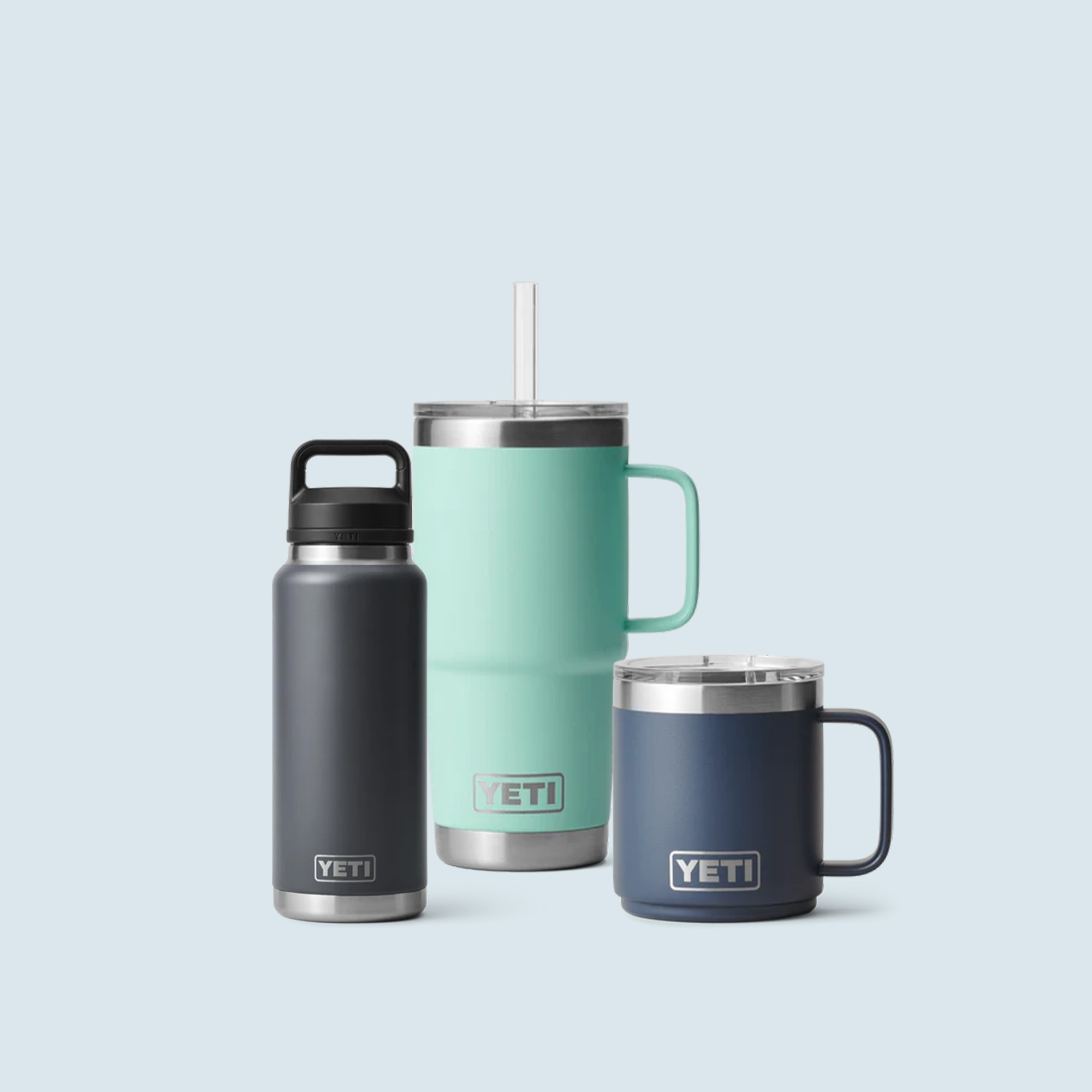
Two of the most popular categories in branded drinkware. Both used daily. Both built to last. But they are not interchangeable. Here is how to decide which is right for your brief.
Water bottles and travel mugs are the two products our team at Curious Vision gets asked about more than almost anything else in the branded drinkware category. But they are not the same product, and choosing between them is not a trivial decision. A water bottle given to a commuter who drinks three coffees a day is a missed opportunity. A travel mug given to a gym-going, outdoor-living, permanently-hydrated audience is the wrong call. The right choice depends on who your recipients are, how they spend their day and what you want the product to communicate on your brand’s behalf.
This post compares branded water bottles and travel mugs across every factor that matters for branded gifting, from daily use and branding surface to sustainability credentials, price point and occasion fit. By the end, you will have a clear answer for your brief, not a non-committal “it depends.”
At Curious Vision, we are a Hertfordshire-based branded merchandise company working with businesses across the UK and worldwide. We offer free digital proofs, quotes within 24 hours and ordering from as few as 25 units across our full drinkware range.
The Comparison: Eight Factors That Matter for Branded Gifts
1. How Well Does It Fit Into Daily Life?
This is the question that matters most. A branded gift only works if it gets used.
Water bottles slot into the broadest range of daily habits of any drinkware product. Gym in the morning, commute, desk all day, school run, weekend. It does not presuppose a lifestyle or a routine. It just goes wherever the person goes. That universality is the water bottle’s single greatest asset as a branded gift.
Travel mugs are more dependent on a specific context: the commute and the hot drink habit. For someone who travels to work every day and buys a coffee on the way, a quality travel mug is a genuinely transformative gift. They use it immediately. They use it every day. They think of the brand every time they do.
But here is the thing: a significant portion of the UK workforce now works from home for some or all of the week. And a travel mug for someone who does not commute is a product that gets used occasionally rather than daily. That matters for brand impression volume.
2. Which Carries Your Brand Better?
Both are excellent branding canvases. But they are not identical.
Water bottles offer more surface area, particularly at 600ml and above. The tall cylindrical profile is generous and the brand sits clearly whether the bottle is being carried, sitting on a desk or held during a workout. More surface area means more flexibility for complex logos, wordmarks and design-led artwork.
Travel mugs are more compact and tapered, which requires more considered logo placement. The upside is visibility in environments the desk mug never reaches: coffee shops, train carriages, meeting rooms. Your brand is seen in social and professional contexts that deliver a different kind of impression to the one it gets sitting on a desk.
One practical detail worth mentioning: the lid. On a travel mug, the lid is part of the visual impression the product makes. Choosing a product where the lid colour and finish complement rather than clash with the branded body is a small decision that makes a noticeable difference.
3. Which Has the Stronger Sustainability Story?
Both categories carry genuine, substantive sustainability credentials. But they tell different stories.
The water bottle story is blunt and universal: every reusable bottle replaces hundreds of single-use plastic bottles every year. It is a simple calculation, it is immediately understood by any audience and it does not require the recipient to have any particular habits or lifestyle for the story to resonate.
The travel mug story is equally powerful but more specific: a reusable travel mug replaces hundreds of single-use takeaway cups annually. In a country that disposes of billions of disposable coffee cups every year, that is a meaningful impact. But it only lands with recipients who actually buy takeaway hot drinks regularly. For someone who makes all their drinks at home, the story loses some of its punch.
Both categories are available in recycled stainless steel with RCS certification and recycled content figures up to 90% by total item weight. Both can arrive in compostable or fully recyclable packaging. The sustainability infrastructure is equally strong across both.
4. Which Feels More Premium in the Hand?
At equivalent price points, both categories deliver similar perceived value. A well-made recycled stainless steel bottle and a well-made insulated travel mug both read as considered, quality gifts when someone picks them up.
Where it gets interesting is at the premium branded end of the market. Stanley, YETI and Camelbak have created genuine consumer desirability in the drinkware category. People covet these products. They buy them for themselves. They talk about them. When your logo sits alongside one of these names, the association does real work.
The one place where the travel mug edges ahead is personal gifting occasions. A travel mug as a Christmas gift, a work anniversary present or a thank-you for a long-standing client feels specific and considered in a way that a water bottle, for all its virtues, slightly less often achieves. It presupposes something about the recipient. It says: we know something about you and we chose this because of that.
5. Which Works for More People?
This is where the water bottle pulls away.
A water bottle works for office workers, home workers, gym-goers, parents, students, outdoor enthusiasts, cyclists and commuters. It does not ask anything of its owner except that they stay hydrated, which is something every person on earth needs to do.
A travel mug works brilliantly for a specific subset of that group: the people who commute, who drink hot beverages and who have a morning routine that a travel mug improves. That subset is large. But it is not everyone.
For large-scale programmes, welcome kits going to mixed workforces or event giveaways where the audience profile is broad or unknown, the water bottle is the safer product. You will not miss with it the way you might occasionally miss with a travel mug.
6. What Does the Budget Look Like?
Both categories span a wide price range. But they do not behave identically as the budget goes down.
Water bottles hold their quality well at lower price points. A good-value recycled stainless steel bottle is still a good product: it hydrates effectively, it brands well and it lasts. The lid is a transport mechanism, not a performance feature, so the quality threshold is lower.
Travel mugs are more sensitive to budget at the lower end. The lid is the whole point of a travel mug. A lid that leaks, sticks, scalds or simply does not work well makes the product a daily frustration rather than a daily pleasure. And a branded product that frustrates its owner every morning is not the association any business wants to build.
Practical implication: if budget is a genuine constraint, stretch it further on a travel mug than you would on a water bottle. The floor for a travel mug that actually performs well is higher.
7. Which Suits Your Gifting Occasion?
Some occasions point clearly to one product or the other.
A new starter welcome kit for a field sales team who spend their days driving between meetings calls for a travel mug. A welcome kit for a company with a mixed remote and office workforce calls for a water bottle. A Christmas gift for senior clients who commute into the city calls for a travel mug. A giveaway at a half marathon calls for a water bottle.
When the occasion is less clear-cut, ask what the product needs to communicate. If it needs to be universally useful, go water bottle. If it needs to feel specific and personal, go travel mug.
8. Which Lasts Longer and Delivers More Over Time?
Both categories, at quality price points, are built to last years. That longevity is the commercial and environmental argument for investing in quality in the first place.
Water bottles accumulate more total brand impressions over a product lifetime because they travel across more contexts and reach more different people. The brand does not just get seen by the person using it. It gets seen by everyone in the environments that person moves through.
Travel mugs deliver fewer total impressions but in more specific, often social environments. A branded travel mug in a coffee shop is a different kind of visibility to a branded water bottle on a desk. Both have value. They are different types of value.
So Which Should You Choose?
Choose a water bottle if:
- You do not know your audience well enough to be confident about their daily routine. The water bottle works for everyone and that matters.
- The brief is a large-volume giveaway, a welcome kit for a mixed workforce or any programme where universal applicability is the priority.
- Budget is a consideration and you want the strongest possible product at a given price point.
- The sustainability message is central and you want it to land clearly with every recipient regardless of their habits.
- Your recipient group includes a meaningful proportion of people who work from home.
Choose a travel mug if:
- Your audience is urban, office-based and commuter-heavy. The daily use frequency for this group is exceptional.
- The occasion is personal: a Christmas gift, a work anniversary, a thank-you for a senior client. The travel mug earns its place as the more considered choice in these contexts.
- You want the product to feel specific rather than universal. A travel mug presupposes something about the recipient and that specificity is part of its appeal.
Choose both if:
The budget allows and the brief calls for it. A water bottle and a travel mug together cover every hydration occasion from the commute to the gym to the desk. As a combined gift, they make one of the strongest impressions in the drinkware category. For premium welcome kits and executive gifting programmes, this is worth serious consideration.
Frequently Asked Questions
What is the difference between a branded water bottle and a travel mug?
A branded water bottle is designed primarily for cold or ambient temperature hydration throughout the day. It typically has a wider mouth, a higher capacity and a lid that functions as a transport seal. A travel mug is designed primarily for hot beverages consumed on the move, with a narrower mouth, a lower capacity and a lid designed to be drunk from directly. Both are available in similar materials and at similar price points, but they suit different audiences and different daily routines.
Which is better for corporate gifting, a water bottle or a travel mug?
It depends on the audience and the occasion. Water bottles are the stronger choice for mixed audiences, volume gifting programmes, active recipients and any brief where universal applicability matters. Travel mugs are the stronger choice for commuter-heavy urban audiences, premium client gifting, personal occasions and any brief where a more specific, considered product is called for.
Are travel mugs or water bottles more sustainable?
Both categories carry strong sustainability credentials when made from recycled stainless steel with RCS certification. The environmental narrative is slightly different for each: a water bottle replaces single-use plastic bottles, while a travel mug replaces single-use takeaway cups. Both are compelling stories. The most sustainable choice is the one the recipient will actually use every day for years.
What is the best branded drinkware for a staff welcome kit?
For most welcome kits, a premium recycled stainless steel water bottle is the strongest single product choice because it works for every recipient regardless of their daily routine. For commuter-heavy workforces, a travel mug is an equally strong choice. For premium welcome kits with the budget to do both, a water bottle and travel mug together cover every hydration occasion across the recipient’s full day.
Can you use a travel mug for cold drinks?
Yes. Many modern travel mugs are used for cold drinks, and double-wall insulated travel mugs keep cold drinks chilled effectively. However, the lid mechanism on most travel mugs is designed with hot drinks in mind. If cold drinks are the primary use case, a wide-mouth insulated water bottle is generally a more comfortable and practical drinking experience.
What is the minimum order quantity for branded travel mugs and water bottles?
At Curious Vision, both categories are available from a minimum of 25 units, with a free digital proof included and quotes turned around within 24 hours.
The Bottom Line
Water bottles and travel mugs are both excellent branded gifts. Both deliver daily brand visibility, both carry credible sustainability stories and both communicate something genuinely positive about the business behind them.
The decision between them comes down to three things: who the recipients are, how they spend their day and what the gifting occasion calls for. For mixed or broad audiences, the water bottle is the safer and often stronger choice. For commuter-heavy, coffee-loving urban professionals and personal gifting occasions, the travel mug earns its place.
If the brief allows for both, do both. A water bottle and travel mug together cover every hydration moment across a full day and make one of the strongest combined branded gifts in the drinkware category.
Whatever direction your brief takes you, the Curious Vision team is ready to help. Send us your project details and we will have a free digital proof and a full quote back to you within 24 hours, from as few as 25 units, with delivery anywhere in the world.
Not sure which is right for your brief? Let us help. Get Your Free Mockup and Quote →
Free digital proof included. From 25 units. Quote within 24 hours. Worldwide delivery available.
You might also like:
- The 10 Best Brandable Stainless Steel Water Bottles for Businesses
- How to Build a Branded Drinkware Bundle That Clients Will Actually Keep
- The Complete Guide to Sustainable Branded Drinkware for Businesses